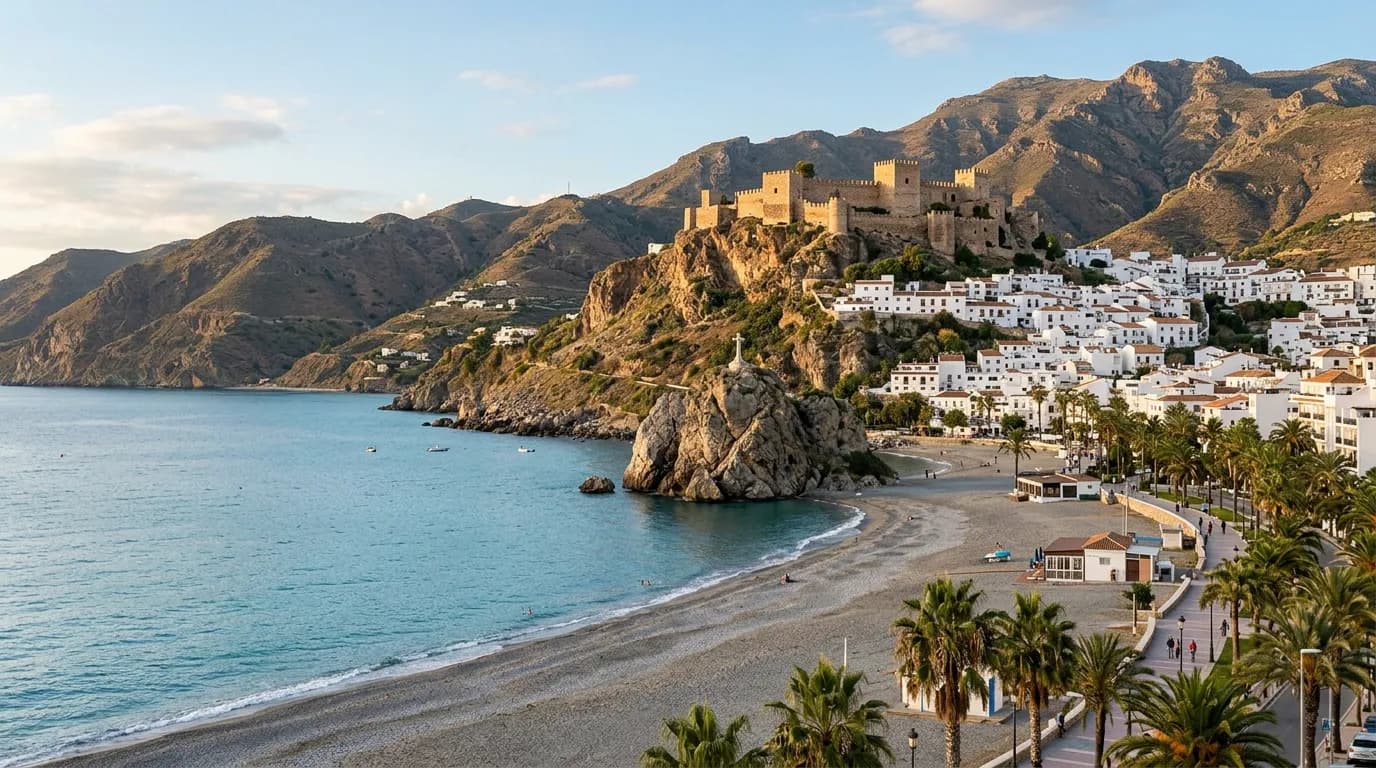
This Almuñécar travel guide helps you plan a visit to the Costa Tropical. Almuñécar lies in the province of Granada, between the Mediterranean and steep mountains. It is a genuinely Spanish seaside town with a Roman past, a castle above the old quarter and pebble beaches on both sides of a striking rock.
Below you will find the best things to do in Almuñécar, from beaches and tapas to day trips to Granada and the Alpujarras. Every figure comes with its source. We checked prices and opening hours on 11 October 2026; they may have changed since.
The weather by season
On average 2,905 hours of sunshine and 534 mm of rain a year.
Winter (Dec–Feb)
- Temperature
- 16.8–17.7 °C by day · 7.4–8.9 °C at night
- Sunshine
- 160–180 hours of sunshine a month
- Rainfall
- 60–100 mm of rain a month
Spring (Mar–May)
- Temperature
- 19.6–24.3 °C by day · 9.8–14.2 °C at night
- Sunshine
- 222–292 hours of sunshine a month
- Rainfall
- 20–52 mm of rain a month
Summer (Jun–Aug)
- Temperature
- 28.1–30.8 °C by day · 18.0–21.1 °C at night
- Sunshine
- 316–347 hours of sunshine a month
- Rainfall
- 0–6 mm of rain a month
Autumn (Sep–Nov)
- Temperature
- 20.1–28.2 °C by day · 11.3–18.8 °C at night
- Sunshine
- 172–255 hours of sunshine a month
- Rainfall
- 20–100 mm of rain a month
Source: AEMET, climate normals 1981–2010, Málaga Aeropuerto station (approx. 70 km further west). A guide, not an exact value for Almuñécar.
1. Location and climate
Almuñécar lies on the Granada coast, about 80 km south of the city of Granada. Behind the coast, the mountains rise towards the Sierra Nevada. These ranges block cold northerly winds, giving this strip its own mild microclimate, where even tropical fruit such as cherimoya and avocado grows.
According to the Consejo Regulador for the cherimoya, the average yearly temperature in the area is between 16.8 °C (Salobreña) and 19.1 °C (Nerja). AEMET does not publish long-term normals for Almuñécar itself. The nearest coastal series is Málaga Aeropuerto, some 70 km further west, which averages 2,905 hours of sunshine and 534 mm of rain a year (AEMET, 1981–2010). Treat the table as a guide, not an exact value for Almuñécar.
| Season | Avg. max. | Avg. min. | Sunshine a month | Rain a month |
|---|---|---|---|---|
| Winter (Dec–Feb) | 16.8–17.7 °C | 7.4–8.9 °C | 160–180 hours | 60–100 mm |
| Spring (Mar–May) | 19.6–24.3 °C | 9.8–14.2 °C | 222–292 hours | 20–52 mm |
| Summer (Jun–Aug) | 28.1–30.8 °C | 18.0–21.1 °C | 316–347 hours | 0–6 mm |
| Autumn (Sep–Nov) | 20.1–28.2 °C | 11.3–18.8 °C | 172–255 hours | 20–100 mm |
Source: Consejo Regulador DOP Chirimoya Costa Tropical; AEMET – climate normals Málaga Aeropuerto 1981–2010 (consulted 11 October 2026).
2. History and sights
In ancient times Almuñécar was called Sexi. The Phoenicians founded a trading post here and the Romans turned it into a prosperous town, known for salted fish and fish sauce. That history is still within walking distance.
- El Majuelo: in a botanical park below the castle lie the remains of a Roman fish-salting factory. Entry is free; open 9:00–21:30 in spring and autumn and 9:00–23:00 in summer (Diputación de Granada).
- Castillo de San Miguel: the castle above the town dates back to Roman and Moorish building phases. A combined ticket with the Cueva de Siete Palacios costs €4 (reduced €2.50); with the Museo Claves included, €5. Open Tuesday to Saturday, 10:00–13:00 on Sundays, closed on Mondays (Ayuntamiento, 2026).
- Barrio de San Miguel: the old quarter around the castle, with narrow white streets and stairs. Wear sturdy shoes, as it is steep.
- Peñón del Santo: the rock with a cross that separates Puerta del Mar and San Cristóbal beaches. At the top is a viewpoint over the coast.
Source: Diputación de Granada – El Majuelo Roman fish-salting factory; Ayuntamiento de Almuñécar – Castle, Cueva de Siete Palacios and Museo Claves; Turismo Almuñécar (official tourism site) (consulted 11 October 2026).
3. Beaches
Almuñécar's beaches are mostly grey sand and pebbles. Bring water shoes, especially with children.
- San Cristóbal: the long town beach west of the Peñón del Santo, with a promenade and beach bars.
- Puerta del Mar: the central beach on the east side of the rock, close to the old quarter.
- Velilla: further east, long and wide, with a cycling and walking promenade.
- La Herradura: a horseshoe-shaped bay about 7 km away (10 minutes by car, OSRM), popular for diving and kayaking. See also our La Herradura area guide.
- Cantarriján: a naturist beach in the protected Acantilados de Maro-Cerro Gordo nature area. In summer, car access is restricted and a shuttle bus runs 9:00–21:00, roughly every 10 to 15 minutes. A return ticket costs €3 (Europa Press, June 2026).
Source: Turismo Almuñécar (official tourism site); OSRM route planner (OpenStreetMap); Europa Press – Cantarriján shuttle bus 2026 (consulted 11 October 2026).
4. Food and drink
In the province of Granada, many bars serve a small tapa with your drink. On the beach in summer you will often see espetos: sardines on a skewer, grilled over a fire in a sand-filled boat. Be sure to try the cherimoya too. The fruit has a protected designation of origin here and, according to the Consejo Regulador, is in full season in October, with the harvest running into May.
Five places to start with. We only list places that appear in a local guide; reviews are subjective, so also have a look on Google Maps or TripAdvisor.
| Place | Where | Tip |
|---|---|---|
| La Bodeguita | Calle Manila 8, centre | Known for fried fish and fried aubergine. Closed on Mondays; check the seasonal hours. |
| Bodega Francisco I | Centre | A classic bodega from the official restaurant guide: a good place to try tapas with a drink. |
| Bodega La Barrica | Almuñécar | Listed in the official restaurant guide. Go early in the evening, when it is usually quieter. |
| Don Olivo | Almuñécar | Listed in the official restaurant guide. Book ahead in July and August. |
| MarDela Gastro-restaurante | Almuñécar | Listed in the official restaurant guide, for something more modern than classic tapas. |
Source: Consejo Regulador DOP Chirimoya Costa Tropical; Visit Almuñécar – restaurant guide; Guía de Almuñécar – La Bodeguita (consulted 11 October 2026).
5. Day trips from Almuñécar
Almuñécar makes a good base. The distances and driving times below were calculated with the OSRM route planner (OpenStreetMap) from the town centre, without traffic. Allow more time in summer and around Granada. Almuñécar has no train station: travelling by train, you arrive in Granada (Renfe) and take the Alsa coach from there.
Alhambra: buy your tickets in advance on the official site. A general ticket costs €22.27 and a ticket for the gardens, Generalife and Alcazaba €12.73, including service fees. Bring your original ID. When we checked, the official ticket site said the Alcazaba was closed for safety reasons and that the Nasrid Palaces could be visited on an adapted route.
| Destination | Distance | By car | Transport |
|---|---|---|---|
| Salobreña | 13 km | approx. 17 min | Car or Alsa coastal bus (check the timetable). |
| Nerja | 23 km | approx. 25 min | Car or Alsa coastal bus (check the timetable). |
| Frigiliana | 26 km | approx. 29 min | Car; by bus usually via Nerja (check the timetable). |
| Granada and the Alhambra | 80 km | approx. 1 h 10 | Car or Alsa coach: the first Comfort coach leaves Granada at 07:00 and arrives at 08:15, so approx. 1 h 15. |
| Alpujarras (Lanjarón / Pampaneira) | 49 / 58 km | approx. 45 min / 1 h 05 | A car is most practical; bus connections usually run via Granada. |
Source: OSRM route planner (OpenStreetMap); Alsa – Granada–Almuñécar coach; Renfe (trains to Granada); Alhambra – official ticket site (consulted 11 October 2026).
6. When should you go to Almuñécar?
- Spring (March–May): pleasantly warm for walking and day trips, with fewer crowds. The sea still feels cool.
- Summer (June–August): the warmest and driest time, but also the busiest. Parking and restaurants take patience; book ahead.
- Autumn (September–November): the sea is still warm from the summer and it gets quieter. The cherimoya season starts in October; November is on average one of the wettest months.
- Winter (December–February): mild, with plenty of sunshine for the time of year. Ideal for a quiet break or wintering, less so for swimming.
Source: AEMET – climate normals Málaga Aeropuerto 1981–2010; Consejo Regulador DOP Chirimoya Costa Tropical (consulted 11 October 2026).
7. Be careful with general tips
- Prices and opening hours change, often by season. Always check them just before your visit.
- Summer is busy, especially in August. If you want peace and quiet, choose spring or autumn.
- The sea is still cold in spring, even when the air is already warm.
- Reviews are subjective and quickly out of date. Look at recent ratings and several sources.
- Parts of the Alhambra can be closed temporarily. That was the case when we checked on 11 October 2026.
Source: Alhambra – official ticket site (consulted 11 October 2026).
8. Budget for more than your accommodation
- Parking: in the centre and near the beaches it is full in summer and often paid. Check the signs locally.
- Transport: a hire car gives the most freedom. Alsa runs more than 20 a day between Granada and Almuñécar; fares vary by journey.
- Tickets: allow, among other things, €4 for the castle and Cueva de Siete Palacios, €3 for the Cantarriján shuttle bus and €22.27 for a general Alhambra ticket.
- Food: a drink with a tapa is often good value, but a full meal on the beach costs more. Check the menu first.
- Tourist tax: on 9 October 2026 the Andalusian government again rejected a tourist tax. This may change, so check before you book.
Source: Ayuntamiento de Almuñécar – Castle, Cueva de Siete Palacios and Museo Claves; Europa Press – Cantarriján shuttle bus 2026; Alhambra – official ticket site; Alsa – Granada–Almuñécar coach; Europa Press – Junta on a tourist tax (9 Oct 2026) (consulted 11 October 2026).
Our conclusion
Almuñécar suits you if you are looking for an authentic Spanish seaside town with history, good food and a mild climate, and you enjoy day trips. It is less suitable if you expect fine sandy beaches, want large resorts or hope to see a lot without a car. Thinking of staying longer or buying here? See our Almuñécar area guide, Almuñécar property prices and our properties.
Frequently asked questions
What is there to do in Almuñécar if you only have one day?
Start the morning at the Castillo de San Miguel, then walk through the Barrio de San Miguel to El Majuelo. Have tapas for lunch in the centre and end the day on the Peñón del Santo at sunset. Note that the castle is closed on Mondays, so plan that day differently.
Can you reach Almuñécar and the Alhambra without a car?
Yes. Alsa runs more than twenty coaches a day between Granada and Almuñécar; the fastest Comfort coach takes about 1 hour and 15 minutes. For Frigiliana and the Alpujarras a car is much more practical, as bus connections often involve changes. Always check the current timetable.
When is the best time for a Costa Tropical holiday?
For swimming, July to September are the warmest months, but July and August are also the busiest. May, June and September combine warm weather with fewer crowds. In winter it is mild and sunny for the time of year, which makes Almuñécar a good place to spend the winter.
Are the beaches in Almuñécar sandy?
Mostly not. Most beaches are grey sand and pebbles, such as San Cristóbal and Puerta del Mar. As a result, the water is often clear. Bring water shoes, especially with children. Cantarriján is a naturist beach in a protected nature area, with a shuttle bus in summer.